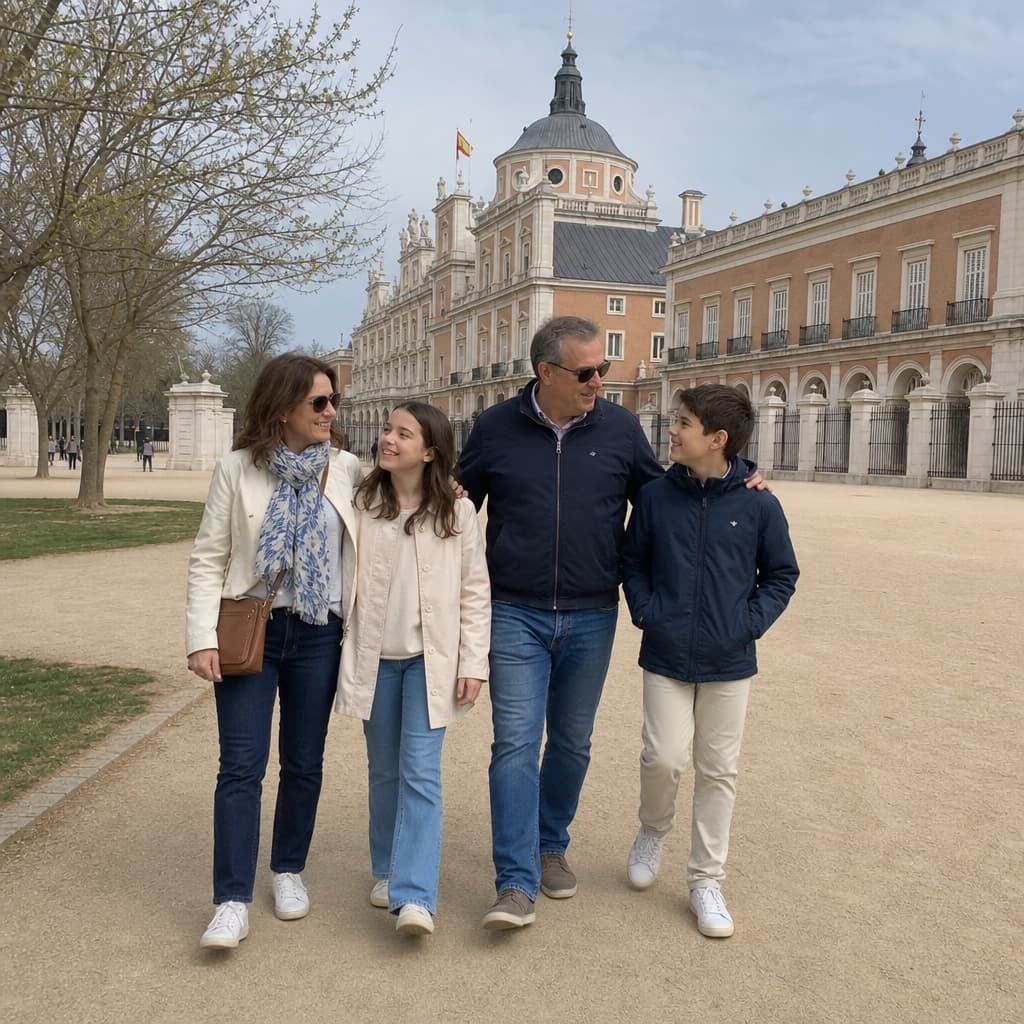
Discover what to do in Aranjuez: explore the gardens of Aranjuez, delight in the local cuisine, and enjoy a unique cultural experience. Visit now!
If you have ever wondered what to do in Aranjuez, get ready to immerse yourself in one of the most fascinating, elegant, and history-rich destinations in all of Spain. Located south of the Community of Madrid, this city is a true green oasis that for centuries served as a place of recreation and rest for Spanish royalty.
Named a UNESCO World Heritage Cultural Landscape in 2001, Aranjuez is not just a collection of palaces and gardens; it is the perfect harmony between human creation and nature. Its perfectly straight grid-like streets, the constant murmur of water, its immense manicured forests, and its unparalleled gastronomy make this town a place you must visit at least once in your life.
In this definitive guide, crafted so you won’t miss a single detail, we are going to break down step-by-step everything this monumental gem has to offer. From planning your trip to the most secret corners of its gardens, join us as we discover the magic of this Royal Site.
Planning Your Visit: Practical Information and Tips
Before diving into the beauty of its monuments, it is essential to organize the logistics of your trip. Aranjuez is a very accessible destination, but knowing a couple of local tricks will save you time and money.
How to Get to Aranjuez from Madrid by Train and Other Transport
The most comfortable, eco-friendly, and popular way to visit the city is by using public transport. If you are wondering how to get to Aranjuez from Madrid by train, the answer is very simple: you need to take the C3 line of Cercanías Renfe (commuter train).
-
Departure Stations: You can catch it at central stops such as Chamartín, Nuevos Ministerios, Sol, or Atocha.
-
Travel Time: Approximately 45-50 minutes from Atocha station.
-
Frequency: There are trains every 15 to 30 minutes, depending on the day and time.
Upon arrival, you will be welcomed by Aranjuez’s beautiful Neo-Mudéjar style station, with its coffered wooden ceilings and decorative tiles, which is a monument in its own right. From there, a pleasant 15-minute walk under century-old trees will lead you straight to the Palace gates.
If you prefer to go by car, the route is via the A-4 highway (Autovía de Andalucía) and takes about 40 minutes from the center of the capital, depending on traffic.
Free Parking Near the Palace of Aranjuez
For those who decide to travel in their own vehicle, parking can be a concern. Fortunately, finding free parking near the Palace of Aranjuez is quite feasible if you know where to look.
-
Calle de la Reina Area: This immense, miles-long tree-lined avenue has angled parking zones in its first sections. It is usually free and is just a five-minute walk from the Palace.
-
Train Station Surroundings: There is a large, free park-and-ride lot. Although you will have to walk a bit further, you are guaranteed to find a spot, especially on high-influx weekends.
-
Trinquete Parking: Near the Plaza de Parejas, there are also usually areas free of parking meters, though they fill up quickly in the morning.
Aranjuez vs. El Escorial Day Trip: Which One to Choose?
It is very common for travelers visiting Madrid with limited time to face the dilemma: Aranjuez vs. El Escorial day trip. Both are spectacular royal residences, but they offer diametrically opposite experiences.
-
Aranjuez: This is the triumph of spring, water, and color. It stands out for its flat terrain, its immense gardens, its relaxed atmosphere, and its more French-inspired, cheerful architecture. It is ideal for families, botany lovers, and those looking for a romantic stroll. The best times to visit are spring and autumn.
-
San Lorenzo de El Escorial: This is all about sobriety, stone, and mountains. It reflects the imperial power of Philip II with an austere, Herrerian style. It is located in the mountains, which means slopes and a cooler climate. It is ideal for lovers of deep history, imposing architecture, and royal crypts.
If you are looking to relax among fountains and nature, Aranjuez is undoubtedly your best choice.
What to See in Aranjuez in One Day: The Crown Jewel
Organizing what to see in Aranjuez in one day requires a bit of strategy, as the distances within the gardens are vast and the palaces require time. The epicenter of any visit must undoubtedly be its palatial heritage.
The Majestic Royal Palace of Aranjuez
This palace, whose facades combine red brick and white Colmenar stone, was commissioned by Philip II in the 16th century, although its current appearance is mainly due to renovations by the Bourbon kings in the 18th century (Philip V, Ferdinand VI, and Charles III).
Touring its interior is like traveling back in time to the era of grand courtly pageantry. Among its most impressive rooms, the following stand out:
-
The Main Staircase: Designed by Giacomo Bonavia, it is crowned by a spectacular chandelier holding more than 200 candles.
-
The Hall of Mirrors: One of the best-preserved rooms, whose style unmistakably recalls the Palace of Versailles.
-
The Porcelain Room: The absolute jewel of the palace. Its walls and ceilings are completely covered with porcelain plaques from the Royal Factory of Buen Retiro, filled with raised Oriental motifs. It is a unique masterpiece in the world.
-
The Smoking Room: An exotic Neo-Nasrid style room inspired by the Alhambra in Granada, commissioned by the king consort Francis of Assisi.
Royal Palace of Aranjuez Hours
To plan your visit, it is essential to know the Royal Palace of Aranjuez hours. Keep in mind that, like almost all National Heritage (Patrimonio Nacional) monuments in Spain, it is closed on Mondays.
-
Winter Hours (October to March): Tuesday to Sunday from 10:00 to 18:00 h.
-
Summer Hours (April to September): Tuesday to Sunday from 10:00 to 19:00 h.
Insider Tip: Ticket offices close one hour earlier. We highly recommend buying your tickets in advance on the official website to avoid the long lines that form on weekends.
La Casita del Labrador
If you find the Royal Palace imposing, wait until you see this recreational «little house.» Hidden deep within the Prince’s Garden, it was built by order of Charles IV. Despite its humble name (called so because it was built over an old farmhouse), its interior houses one of the richest Neoclassical collections in Europe, filled with Valencian silks, Swiss clocks, marble, and mahogany furniture.
Casita del Labrador Tickets and Reservations
Visiting this small palace requires planning. Casita del Labrador tickets and reservations are a delicate matter: access is strictly controlled to protect the fragile floors and interior silks.
-
Advance Booking Mandatory: Visits are exclusively guided and kept to very small groups (often no more than 10 people).
-
Where to Buy: They must be purchased through the National Heritage website well in advance, as they sell out quickly.
-
Distance: Keep in mind that from the Royal Palace to the Casita del Labrador, it is about a 20-30 minute walk through the Prince’s Garden, so calculate your times carefully if you have tickets booked for a specific hour.
A Stroll Through Nature: The Immense Gardens of Aranjuez
If there is one thing that defines and brings worldwide fame to the city, it is the gardens of Aranjuez. They inspired the great composer Joaquín Rodrigo to write his famous «Concierto de Aranjuez». They are divided into several distinct areas, each with its own personality, botany, and architectural style.
Prince’s Garden Aranjuez: Step-by-Step Route
The Prince’s Garden (Jardín del Príncipe) is the largest fenced park in Europe (with a perimeter of about 7 kilometers and spanning 150 hectares). It was created by order of Charles IV and features an English landscape style—wilder, more wooded, and romantic than French gardens.
Doing the full Prince’s Garden Aranjuez route can take you more than three hours, so here are the essential landmarks you cannot miss:
-
Gate of Charles IV: Your usual entry point. Two imposing columns and a wrought-iron gate welcome you.
-
The Roller Coaster (La Montaña Rusa): A small artificial hill that once held a wooden structure for courtly games.
-
The Chinescos Pond (Estanque de los Chinescos): This is, without a doubt, the most photographed and idyllic spot in Aranjuez. It is an artificial lake featuring three pavilions: a classical Greek-style one, a Chinese one (which gives the pond its name), and an Egyptian granite mausoleum.
-
Fountains of Apollo and Narcissus: Hidden among century-old trees, sweetgums, and London planes that reach heights of over 40 meters.
-
La Casita del Labrador: (Previously mentioned), located at the end of the garden route.
The Island Garden and the Parterre Garden
While the Prince’s Garden is a bit further from the main palace, the Parterre Garden (Jardín del Parterre) is the first thing you see when standing in front of the Royal Palace’s eastern facade. Clearly French-inspired, it stands out for its geometric boxwood parterres, seasonal flowers, and marble statues.
On the other hand, the Island Garden (Jardín de la Isla) is flanked by the Tagus River and an artificial canal. It is the oldest garden, dating back to the Habsburg era (Philip II). Walking through it means discovering spectacular mythological fountains hidden in shaded crossroads:
-
The Fountain of Hercules and the Hydra.
-
The Fountain of Apollo.
-
The Clock Fountain (which projected the shadow of the hours using water).
-
The Fountain of the Boy with the Thorn (Niño de la Espina).
-
The Castanets Waterfall (Cascada de las Castañuelas).
The symphony of water running constantly through these gardens is a foolproof antidote to stress.
Hidden Treasures and Culture by the River
The history of Aranjuez is intimately linked to water. The Tagus River (the longest in the Iberian Peninsula) flows through the city and was used by royalty as a «miniature sea» where lavish parties were celebrated.
Royal Barges Museum of Aranjuez
To understand these festivities, you must visit the Royal Barges Museum (Museo de Falúas Reales), located near the main entrance of the Prince’s Garden. What is a falúa? It is a richly ornamented river pleasure craft.
This small but astonishing museum exhibits the vessels used by kings and queens to navigate the Tagus. Highlights include:
-
The barge of Charles IV, decorated with heraldic motifs.
-
The impressive gondola commissioned by Philip V from Venetian artisans.
-
The barges of Isabella II and Alfonso XII.
Alongside the boats, you will find navigation instruments, miniature bronze cannons used to salute the monarchs, and paintings showing how the river was filled with musicians, ships, and servants in dazzling court spectacles.
Boat Ride on the Tagus River
If seeing the ancient boats makes you want to set sail, you’re in luck. One of the most fun experiences is taking a boat ride on the Tagus River. A tourist vessel popularly known as «El Barco de Aranjuez» or «El Curiosity» operates in the city.
During the trip, which lasts about 45 to 60 minutes, you will navigate the calm waters of the Tagus, observing the wooded banks, herons, ducks, and the lush riverside vegetation that protects the local flora.
Moreover, if you are looking for activities with kids in Aranjuez, this is undoubtedly number one. Many of these boat trips include an audiovisual scavenger hunt, family trivia on board, music, and sometimes visits from costumed characters. The little ones love the experience of sailing, while it offers adults a perfect moment of relaxation with the chance to enjoy a drink on deck.
Exploring the City: Historic Center of Aranjuez Itinerary
It’s not all about the Palace and the Gardens. When thinking about what to do in Aranjuez, omitting the town’s urban layout is a huge mistake. Designed in the 18th century under Enlightenment principles, the center of Aranjuez is a perfect grid, dotted with highly valuable civil buildings.
A great itinerary through the historic center of Aranjuez could look like this:
-
Plaza de Parejas: Start just south of the Royal Palace. It is an immense sandy esplanade where the nobility used to perform the «Juego de Parejas» (an equestrian exhibition). Today, it is flanked by the imposing House of Trades and Knights.
-
Plaza de San Antonio (or de la Mariblanca): This is the communication hub of the historic city. At one end sits the Church of San Antonio, featuring a circular design and porticoed galleries commissioned by Ferdinand VI. In the center of the square is the famous Mariblanca fountain (a statue of Venus).
-
The Corralas of Aranjuez: Strolling along streets like Infantas, Capitán, or Gobernador, pay attention to the traditional residential architecture. Many houses maintain the corrala structure (a central neighborhood courtyard) typical of the 18th and 19th centuries.
-
Mercado de Abastos: A beautiful example of late 19th-century industrial architecture made of exposed brick, iron, and glass—ideal for buying fresh produce from the local orchards.
-
Alpajés Church: Located a bit further east, it was one of the first religious buildings in the area, proudly displaying the cross of the Order of Santiago on its dome.
-
The Bullring and its Museum: One of the oldest in Spain, inaugurated in 1797 by Charles IV, with an interior that preserves the true essence of 18th-century bullfighting.
Best Viewpoints Over the Tagus Valley
To understand why the monarchs chose this location, you have to see it from above. If you have a car or enjoy hiking, you should seek out the best viewpoints over the Tagus Valley.
-
Mirador del Mar de Ontígola: South of the city lies a natural reserve (the Sea of Ontígola, a historic reservoir built by order of Philip II). From the surrounding hills, known as the Paseo de las Vistas, you can contemplate the striking contrast between the aridity of the Castilian plateau and the lush green oasis formed by the Tagus and Jarama valleys in Aranjuez.
-
Cerro de la Pincarra: Offers an exceptional panoramic view to see the geometry of the crops, the historic geometric groves (the famous «Sotos históricos»), and how the city embraces the river.
Local Gastronomy: The Famous Food in Aranjuez
After so much walking, it’s time to recharge your batteries, and the food in Aranjuez will definitely not disappoint. Historically, this city was the pantry of the royal court. The fertile lands bathed by the Tagus and Jarama rivers produce vegetables and fruits of exceptional quality.
The local cuisine revolves around game meat and its wonderful orchards. Traditional dishes like stewed pheasant, garlic rabbit, or the famous frog legs (a nod to its river history) fill the menus of local restaurants.
Where to Eat Asparagus and Strawberries in Aranjuez
If there are two undisputed kings on the local tables, they are asparagus (both green and white) and strawberries (fresas and fresones). If you visit the city in spring, trying them is almost a divine mandate.
Where should you go to eat asparagus and strawberries in Aranjuez?
-
The River Area and Calle de la Reina: This is where legendary restaurants like El Rana Verde (open since 1903) or Restaurante El Castillo are concentrated. They are infallible classics to enjoy grilled wild asparagus as an appetizer, followed by frog legs, and strawberries with whipped cream for dessert.
-
The Historic Center (Calle Infantas and Almíbar): Home to restaurants like Casa José (which held a Michelin star for a long time and laid the foundations for haute cuisine using local vegetables) or Carême, where orchard produce is elevated to an art form. In this area, you will find excellent taverns where the Aranjuez strawberry (smaller, sweeter, and more delicate than greenhouse varieties) is the absolute star.
-
Los Gangos: If you are looking for a more rustic and casual experience, especially during the warmer months, the popular «gangos» (riverside snack bars) are perfect for eating generous portions outdoors in a festive, family-friendly atmosphere.
Don’t forget to pair these delicacies with a wine from the D.O. Vinos de Madrid. Wineries in the Arganda subzone (very close to Aranjuez) are producing top-quality reds and whites.
Unique Experiences: The Strawberry Train
If you want to add an extra touch of magic and nostalgia to your getaway, the way you arrive in the city can be just as special as the destination itself. We are talking about one of the most beloved and long-running tourist initiatives in the Community of Madrid.
Strawberry Train Schedule and Prices
Inaugured in 1984, the Strawberry Train (Tren de la Fresa) commemorates the first railway line in the Community of Madrid, which connected the capital with Aranjuez in 1851 by initiative of Queen Isabella II. It was historically known as the strawberry train because it brought these delicacies to the Madrid court.
The journey takes place in original early 20th-century wooden carriages with open-air balconies, often pulled by a historic locomotive. During the 50-minute trip, stewards dressed in period costumes distribute the famous local strawberries to the passengers.
It is vital to keep an eye on the Strawberry Train schedule and prices if you want to experience this:
-
Schedule: It operates exclusively on weekends during two specific seasons: Spring (from April to June) and Autumn (September and October).
-
Starting Point: The Railway Museum (Museo del Ferrocarril, old Delicias station) in Madrid.
-
Prices and Routes: The basic ticket ranges between 25 and 30 euros for adults (with discounts for children) and includes the round-trip journey plus the strawberry tasting. However, the most interesting options are the «tourist packages» or «Routes» you can add (Strawberry and Cream Route, Tagus Route, Gardens Route). For a higher price (between 35 and 50 euros), these include bus transfers from the Aranjuez station, guided tours of the Palace, boat rides, or trips on the Chiquitrén tourist train.
Important Note: Tickets go on sale weeks before each season and fly off the shelves, so advance booking through the official channels of Renfe or the Spanish Railways Foundation is highly recommended.
Conclusion: Your Adventure in the Royal Site Awaits
As you have seen throughout this extensive guide, deciding what to do in Aranjuez is not a matter of whether there will be enough activities, but how to prioritize them faced with such an avalanche of beauty, history, and culture.
From getting lost in the wooded immensity of the Prince’s Garden to marveling at the porcelain of the Royal Palace; from tasting the delicacies of the riverside orchards to sailing down the historic Tagus River. Aranjuez is a versatile, welcoming, and deeply enriching destination.
Whether you are visiting as a couple looking for romance, with friends for a gastronomic and cultural route, or seeking the best activities with kids in Aranjuez, this World Heritage city has the magical ability to captivate everyone who sets foot in it.
Put on some comfortable shoes, charge your camera battery, make your reservations in advance, and get ready to enjoy one of the most spectacular places in Spain. Aranjuez is waiting for you with open arms and flowing fountains!
Book a table
We'll be delighted to welcome you
Call or write to us to confirm your booking.